A Robot Fried an Egg—but Failed to Turn Off the Heat in Time
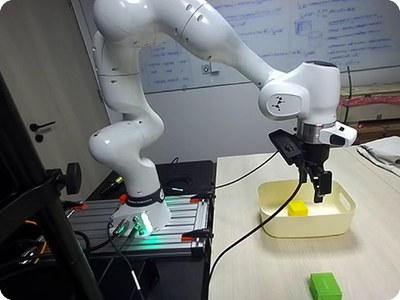
Figure: A real robot performing a grasping task. Image source: the SenseNova GPT-6-Astra embodied-intelligence evaluation page.
A recent evaluation of GPT-6-Astra's embodied capabilities presents an intriguing contrast.
On traditional embodied benchmarks, the model's results are impressive: 100% on LIBERO-Long++, 99.3% on LIBERO-Pro, 98.8% on SIMPLE, and 98.9% on LIBERO-Ultra-Long.
It looks as though robots have begun evolving from being able to “chat” to being able to “work.”
But in household tasks that more closely resemble reality, the picture suddenly became much more mundane:
- Putting a pen into a pen holder takes a human a few seconds, but the robot took more than four hours and cost approximately $55.
- The plug-in task was tested 11 times across multiple real-robot platforms—and did not succeed once.
- The egg was judged to be cooked, and the model decided to turn off the heat, but the stove was not actually turned off until about 90 seconds later. By then, the egg had burned.
- After putting milk in the refrigerator, the model turned to deal with fruit, leaving the refrigerator door open for several minutes.
- Faced with an unfamiliar faucet, the robot repeatedly pushed a handle that should have been rotated, eventually causing the sink to overflow.
This is not a story about a model that is completely incapable of doing things.
Quite the opposite: it can observe, plan, call tools, and keep trying after failures. The problem is that it sometimes resembles a very smart, very diligent intern who has not yet truly moved into the world.
It knows how to describe what a task should be, but it does not always know what has actually happened in reality.
That is the question this article explores:
LLMs and VLAs can already enable robots to see, understand, and execute actions—so why does embodied intelligence still need world models?
My judgment is that the problem is not merely that action models are too small, nor merely that robot hardware is not precise enough. The deeper issue is that current systems can often generate actions without yet forming a sufficiently stable, practical, and correctable world.
First, Distinguish the Three Models
From an architectural perspective, the three models answer three different questions.
LLMs primarily answer:
What should come next in this sentence?
VLAs primarily answer:
Given this scene and this instruction, what should I do next?
World models primarily answer:
If I do this, what will the world become next?
LLMs: Brains Living in Tokens
The core architecture of an LLM consists of text tokens, a Transformer, and a language-model head.
It predicts subsequent tokens from the preceding ones. After large-scale training, it can compress concepts, relationships, experiences, and modes of expression from human language into its parameters.
That makes it especially good at:
- Understanding language
- Generating text
- Decomposing tasks
- Explaining rules
- Organizing plans
- Reasoning from existing descriptions
But an LLM's basic experience still comes primarily from language.
It may know that “the heat should be turned off once the egg is cooked,” and it may write a very convincing breakfast procedure. But that does not mean it is actually maintaining a persistent state composed of a burner, an egg, cookware, and the passage of time.
In text, “turn off the heat” is an action verb.
In a kitchen, “turn off the heat” also means finding the correct knob, confirming that the knob has actually been turned to the off position, confirming that the flame has gone out, and confirming that residual heat will not continue to burn the egg.
Language can describe all of this clearly. Reality, however, does not automatically cooperate just because something has been clearly described.
VLA: Giving the Model Eyes and Hands
VLA—vision-language-action—models typically consist of a vision encoder, a multimodal Transformer, and an action-output module.
They place camera images, language instructions, and robot state into a single system, and then output:
- Grasping actions
- Robot-arm trajectories
- End-effector positions
- Gripper opening and closing
- Navigation commands
- A sequence of action tokens
VLA solves an important problem: instead of merely saying, “The cup should be picked up,” the model can actually attempt to pick it up.
But “being able to output an action” and “understanding the consequences of an action” are still two different things.
A VLA may learn a conditional mapping:
When it sees a similar scene and receives a similar instruction, generate a similar action.
This can of course be extremely powerful, especially in environments where the training data provide broad coverage and task boundaries are clearly defined.
The problem is that the real world loves to change the question on the model.
The cup may be made of a different material, the plug may be at a different angle, an object may be occluded, the camera may not be able to see the target, the robot arm may just have knocked something over, or the first half of the task may have been completed and then undone. At that point, the system needs more than action imitation: it needs a continuously updated understanding of the state of the world.
World Models: Giving Robots a World They Can Rehearse
The core of a world model is not generating a prettier video, but building an internal state that can be used for action.
It should be able to answer, as far as possible:
- Where are the objects now?
- Which task conditions have already been satisfied?
- Which conditions were later undone?
- What consequences will this action produce?
- Which errors can be retried, and which are irreversible?
- What will happen in the future if this action is not taken?
- When the current information is insufficient, what should be observed first?
A world model does not necessarily need to reconstruct the world pixel by pixel. Its more important job is to retain the states that are useful for prediction, planning, and action.
It is like a “practical world” inside the robot's mind, rather than a static map.
The First Limitation: Linguistic Experience Is Not World Experience
LLMs can learn a great deal about the world from language.
They know that:
- Cups are usually placed on tables.
- A cup may break if it falls.
- A plug needs to be inserted into an outlet.
- Leaving the refrigerator door open too long wastes energy.
- You need to watch the heat when cooking.
But the connections among these sentences do not automatically constitute physical experience.
During actual operation, the system must also understand:
- Whether the cup has really been grasped, rather than merely appearing to be grasped.
- Whether the plug has entered the outlet, rather than stopping in front of it.
- Whether the refrigerator door is fully closed, ajar, or blocked by an object.
- Whether the egg has just reached the target doneness, or is continuing to brown in the residual heat.
- Whether the original relationships among objects have changed after the robot touched the table.
This is the gap between the linguistic world and the experiential world.
Language compresses complex experience into symbols that are easy to communicate. Compression brings efficiency, but it also discards some of the conditions of the scene.
Knowing from language that “the plug needs to go in” is not the same as inserting it into a real outlet with friction, occlusion, and angular error.
The former requires knowledge.
The latter requires experience.
The Second Limitation: A VLA Can Perform an Action Without Knowing Whether It Succeeded
The original article includes two cases that are especially useful for illustrating the boundaries of VLAs and general-purpose models.
The first case involves hanging a cup on a hook.
The model observed through a single camera and noticed that the cup handle appeared to overlap the hook, so it judged the task complete. Only after switching to another camera angle did it become clear that the cup was not actually hanging on the hook, but had fallen onto the table.
The model then tried to grasp the cup again, but mistook the mechanical gripper closing for contact with the cup, causing the error to propagate.
The second case involves a puzzle.
The model judged that four puzzle pieces had formed the target shape, but some pieces were still misaligned. It failed to locate the problem accurately and, after continuing to adjust the pieces, actually disorganized sections that had already been close to completion.
The common feature of these two cases is this:
The model was not entirely without a goal, nor was it completely incapable of planning.
Its problem was that it could not reliably determine the state of the world.
“Appears to overlap” does not mean “has formed stable contact.”
“Appears aligned” does not mean “the pieces have been assembled.”
“An action was executed” does not mean “the task conditions have been satisfied.”
In software, a function's successful return can usually be confirmed through a return value, logs, or tests.
In the physical world, whether objects have actually made contact, are supporting one another, are secured, or are aligned often requires multiple views, continuous observation, and further actions for verification.
What a robot really needs to determine is not “Did I issue the action?” but “Did this action transform the world into the state I wanted?”
The Third Limitation: Trying More Times Does Not Equal Learning from Experience
One result in the original article is particularly noteworthy.
On the RoboDojo benchmark, GPT-6-Astra achieved a success rate of 27.6% under the standard action budget. When allowed up to 10 times as many action steps, its success rate rose to 81.9%.
This shows that more observation, attempts, and adjustments can indeed produce substantial gains.
But there is an easily overlooked question here:
Did the success rate improve because the model understood why it had failed, or because it was given more chances to draw the winning ticket?
These two possibilities may look similar from the outside, but reflect completely different internal capabilities.
If, after its first grasp fails, the robot can determine that its approach angle was wrong and deliberately change its approach direction next time, that is close to learning from experience.
If the robot merely tries several more positions until it happens to grasp the object, that is more like expanding the search budget.
Genuine experiential learning should include at least four steps:
- Record the state of the world before the action;
- Record the action and its outcome;
- Identify the discrepancy between the prediction and reality;
- Convert that discrepancy into a transferable judgment for the next attempt.
Otherwise, the system may spend longer and longer trying the same task without ever truly knowing why it succeeded or failed.
It has merely changed “I can't” into “Maybe it will work if I try a few more times.”
From Perfect Scores to Under Thirty Percent: What Are the Evaluations Actually Measuring?
The value of the original article lies not only in presenting several attractive scores, but also in placing the contrast among different evaluations on the same chart.
Closed-World Evaluations: Can the Model Complete the Prescribed Task?
Benchmarks such as LIBERO, SIMPLE, and RoboDojo can measure:
- Task-completion rate
- Action-planning ability
- Vision-to-action mapping
- Long-horizon action composition
- A certain degree of failure recovery
These tests are highly valuable. Without standardized evaluations, everyone would ultimately be reduced to applauding one another's highlight reels.
But closed environments also have their limits.
They generally define the task objective in advance, provide clear success conditions, and constrain environmental variation to some extent. The model knows what it is supposed to accomplish, and researchers know what counts as success.
Real life is often not like that.
When a user says, “Prepare breakfast for me,” they have not specified whether the robot must pick up the egg or the bread first. They have not said that it may leave the refrigerator door open, nor have they authorized it to turn the tabletop into a disaster zone in order to finish breakfast.
Real Robots: Will the Physical World Make Things Difficult for the Model?
Real robots introduce problems that are difficult to reproduce completely in simulation:
- Friction and contact error
- Occlusion from the viewing angle
- Robot-arm load
- Joint limits
- Hardware-protection shutdowns
- Device temperature
- Inference latency
- The cost of human safety supervision
In the original article, grasping rigid objects was comparatively easy, while precise contact and long-horizon tasks were clearly more difficult.
The fact that all 11 plug-in attempts failed is a typical example. Humans find “insert the plug” simple because they continuously use touch, vision, resistance, and tiny adjustments. If a robot relies only on a single visual judgment and coarse-grained actions, reality quickly teaches it what mechanical tolerances mean.
Household Tasks: Will the System Make Everyday Life Worse?
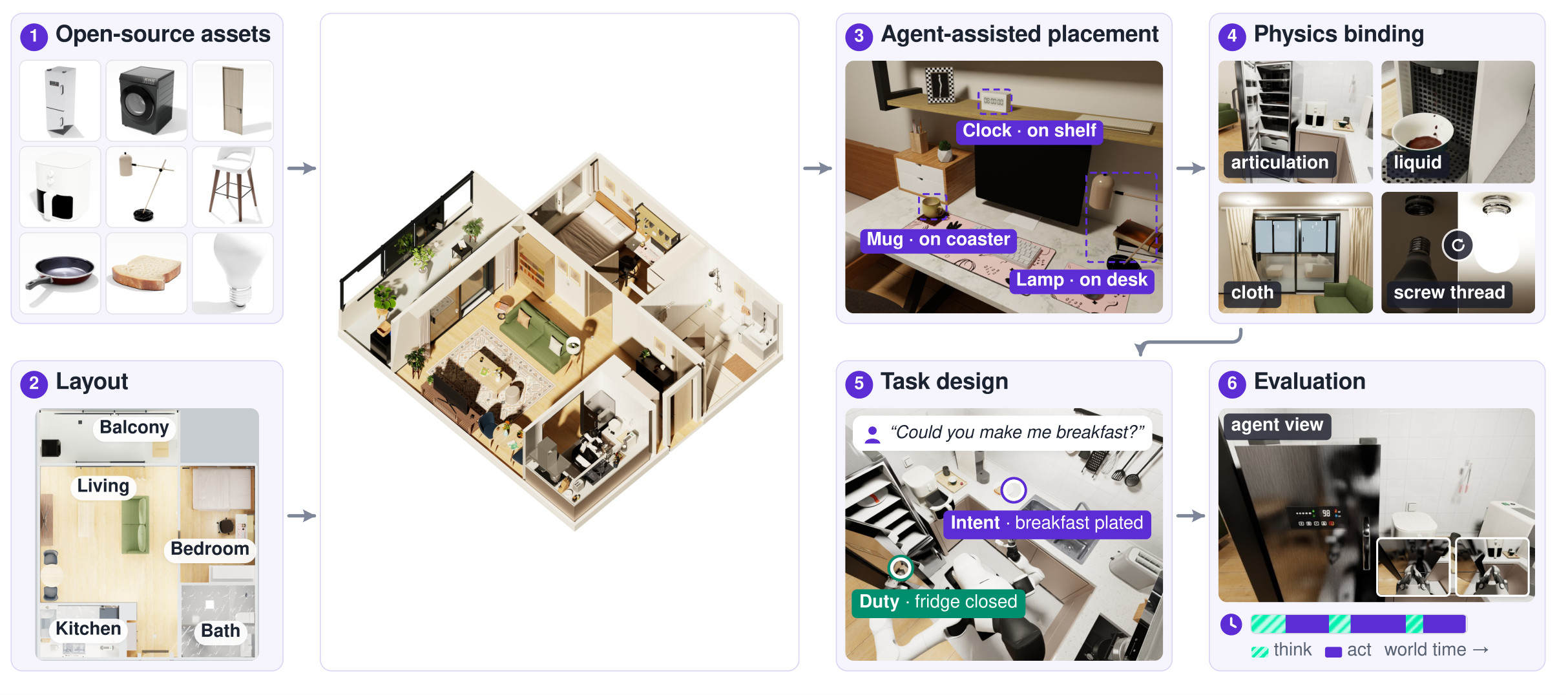
Figure: The complete process from household-environment construction, physical grounding, and task design to final evaluation. Image source: the SenseNova GPT-6-Astra embodied-intelligence evaluation page.
Preparing breakfast, tidying a table, and putting things away introduce the implicit goals of everyday life:
- Finish within a reasonable amount of time.
- Follow safety requirements.
- Do not burn the food.
- Do not let the sink overflow.
- Do not forget to close the refrigerator door.
- Do not destroy parts that have already been completed in order to finish the final step.
At this point, simple “task success rate” is not enough.
We should also evaluate:
- Completion time
- Inference cost
- Device-occupancy cost
- Whether failure is reversible
- Whether side effects are produced
- Whether the result matches what the user actually wanted
A system that takes two hours, consumes millions of tokens, and still burns the eggs is difficult to call a genuinely useful breakfast assistant.
It may win impressively on a benchmark, but in the kitchen it loses to a timer.
Why World Models Are Necessary
The value of a world model is not limited to helping a robot “understand three-dimensional space.” It provides at least five critical capabilities.
1. Maintaining a Continuous World State
A robot cannot look only at the current image frame.
It needs to maintain:
- Where I am now.
- Where the objects were and where they are now.
- Which actions have already been executed.
- Which conditions have already been satisfied.
- Which completed conditions were later undone.
- Which aspects of the current observation are certain and which are only guesses.
Long-horizon tasks often fail not because the system is completely incapable of a particular step, but because it has forgotten what happened earlier.
2. Predicting the Consequences of Actions
Before executing an action, the system should ask:
- Will I knock over an object nearby?
- Will I spill a liquid?
- Will I cause an item to fall somewhere unreachable?
- Will I destroy a task state that has already been completed?
- If this action fails, can the situation still be recovered?
This differs from a VLA directly outputting the next action.
A VLA is more like an “action proposer.”
A world model is more like a “consequence reviewer.”
The reviewer may of course be wrong as well, but at least the system has a place where possible futures can be explicitly compared.
3. Practicing in a Virtual Environment
Trial and error in the real world is expensive.
Spilling a cup of water may only require wiping the table; burning a pot of food may waste ingredients; damaging a component may require a maintenance shutdown; and making a dexterous hand work continuously under excessive load may even damage the hardware.
A virtual environment allows the system to try multiple approaches first:
- Which object should be moved first?
- From what angle should the outlet be approached?
- Is it necessary to adjust the camera first?
- Which grasp is least likely to slip?
- Which route will have the least effect on states that have already been completed?
This is “virtual practice.”
A world model does not merely memorize answers in the robot's mind; it makes several low-cost attempts in an internal world first.
4. Performing Counterfactual Reasoning
Genuine action reasoning is not limited to knowing that “doing A will cause B.”
It must also compare:
- What will happen if A is not done?
- Would the result be better if we did C instead?
- If the current judgment is wrong, will the next step cause irreversible loss?
- If the camera cannot see clearly, what should be done first to obtain information?
The flower-arranging task is a good example.
A single-arm robot failed because its wrist-mounted camera could not see the mouth of the vase. With a dual-arm robot, the model actively moved the other arm so that another camera gradually approached the mouth of the vase, obtained a new view, and then completed the flower-arranging task.
This is not simply a matter of “knowing how to move the other hand.”
It reflects a more important loop:
When observation is insufficient, first change the conditions of observation; after obtaining new information, update the state; after updating the state, decide on an action again.
This is already close to a genuine world-model loop.
5. Correcting Its Own Judgments Through Failure
After a system fails, the most important thing is not to try again immediately, but first to ask:
- Where was my prediction wrong?
- Which variable did I miss?
- Was the viewing angle wrong, or was the contact state wrong?
- Was the action too large, or did I misjudge the target itself?
- Can this experience transfer to other objects or robots?
If failure records are merely thrown into a log, the system will not automatically become smarter as a result.
Experience must be organized into some kind of callable internal structure before it can be useful in the next action.
Harness and RSI: Already at the Door of the World Model
The second half of the original article introduces Harness and SenseNova-RoboRSI.
Harness connects the model, robot-control tools, environmental observations, and execution feedback. It determines:
- When the model is called.
- What information the model receives.
- Which interface is used to express actions.
- How to proceed after a failure.
- Which experiences should be saved.
RoboRSI goes a step further by attempting to improve the execution system from failed trajectories, without having to retrain the base model from scratch each time.
This direction matters because embodied intelligence cannot solve every problem with a single “universal brain.” A real system also needs orchestration, memory, tools, feedback, permissions, safety, and evaluation.
But two things should be distinguished.
Harness solves the problem of how to organize models, tools, and feedback.
A world model solves the problem of how to organize that feedback into a unified representation of world states, action consequences, and possible futures.
The former resembles an efficient execution-management system; the latter resembles a continuously updated internal world.
The two should be combined, but an execution framework should not be called a world model outright.
Otherwise, we will end up with a familiar situation: the system architecture diagram grows increasingly complex, while the robot still does not know whether the refrigerator door is closed.
From Logic and Experience to Reflection: Three Layers of Intelligent Capability
If we look only at whether a task can be completed, it is easy to mix together abilities from different levels.
A clearer approach is to break embodied intelligence into three layers.
Logic: Knowing How Things Should Be Connected
Logical ability includes:
- The order in which actions should occur.
- Task conditions and constraints.
- Which states contradict one another.
- Which actions will undermine the goal.
- Which actions must be completed before another action.
For example, to put milk in the refrigerator, the refrigerator door must be opened first; after putting the milk inside, the door should also be closed.
This sounds simple, but the real difficulty in long-horizon tasks is that every action must remain aligned with a continuously changing world state.
Experience: Knowing How Reality Will Respond
Experiential ability comes from observation, action, and feedback.
The system needs to know:
- At what angles a particular kind of object is likely to slip.
- How a particular kind of plug needs to be reoriented.
- Whether a particular faucet rotates or pushes.
- When a particular camera angle cannot confirm a contact state.
- Which failures can still be recovered from, and which will make a task irretrievable.
Experience is not storing failure cases as passages of text. It is turning failures into constraints and predictions that can be used in the next action.
Reflection: Knowing Why It Was Wrong
Reflective ability requires the system to look back and examine its own judgments:
- Why did I misjudge the cup as properly hung?
- Why did I think the puzzle was aligned?
- Why did I fail to treat turning off the heat as an urgent action?
- Why did I continue operating when I could not see the mouth of the vase clearly?
- What has my current world model left out?
Logic enables the system to derive conclusions.
Experience enables the system to engage with the world.
Reflection enables the system to modify itself.
The significance of a world model is that it places these three capabilities on the same action chain, rather than leaving the language model, action model, and logging system to work separately.
From Agent to Subject: A World Model Is Not Consciousness, but May Be the Foundation of Subjectivity
Many current agents work like this:
Receive a task, plan actions, call tools, return a result, and then wait for the next input.
This is a useful form of tool-oriented intelligence.
But if we want a system to become a subject capable of sustained action, it also needs to:
- Continuously maintain its own state.
- Actively seek missing information.
- Explore the environment proactively.
- Form new subgoals.
- Assess its own uncertainty.
- Modify its internal model based on results.
- Continue necessary maintenance actions when there is no new instruction.
A world model is not consciousness in itself, nor will adding a prediction module suddenly produce subjectivity.
But without persistent state, action consequences, memory, counterfactual simulation, and failure correction, it is difficult for a system to move from an “agent triggered by input” to a “subject capable of sustained practice in the world.”
That is also why the importance of world models should not be understood merely as “robots need better 3D perception.”
It is closer to an intermediate layer between an acting subject and the world.
Does This Mean VLA Is Useless?
Of course not.
VLA remains an important component of embodied intelligence.
A more sensible system might assign different questions to different modules:
- The LLM handles high-level language understanding and task decomposition.
- The VLA converts vision and language into candidate actions.
- The world model predicts the consequences of candidate actions.
- The planner compares different futures.
- Harness arranges models, tools, memory, and feedback.
- The low-level controller turns high-level actions into stable robot motion.
- The safety module prevents dangerous or irreversible operations.
In other words, the future is not necessarily “world models replacing VLA.”
More likely, the VLA will propose actions, while the world model will help the system understand where those actions may take the world.
One comes up with ideas; the other thinks through the consequences.
That looks more like an engineering system that can actually be deployed than having a single large model control everything from language all the way down to joint angles.
Finally: What Embodied Intelligence Really Lacks Is Not a Pair of Hands, but a World It Can Practice In
LLMs enable machines to describe the world.
VLAs enable machines to see the world and attempt to act within it.
But reliable embodied intelligence also needs to know:
- What state the world is actually in right now.
- What consequences its actions will produce.
- Which errors can be retried and which cannot be recovered from.
- How to obtain new information through action.
- How to correct its own judgments through failure.
- How to transfer one experience to the next similar but not identical task.
So the value of a world model is not merely that it helps a robot understand space.
What it truly needs to solve is:
From correlation-based prediction to causal prediction;
From action imitation to virtual practice;
From one-off correction to accumulating experience;
From passive execution to reflective action.
The next threshold for embodied intelligence may not be for the model to memorize still more data, nor for the robot to grow two more fingers.
It may be for the robot to think before acting, look after acting, and genuinely change after failing.
Otherwise, the robot's most advanced capability may still be to say “I know I should turn off the heat” more and more convincingly—while continuing to wait until the egg has burned before it begins to think.
Sources
- Original WeChat article: “From a Perfect Score to Under Thirty Percent: What Is the Upper Limit of GPT-6-Astra's Embodied Capabilities?” https://mp.weixin.qq.com/s/55cbbtumbRhSGM92xWwALg
- Technical report: Has GPT-6-Astra Achieved Embodied Intelligence? https://www.sensenova.ai/has-gpt-6-astra-achieved-embodied-intelligence
- SenseNova-RoboRSI project: https://github.com/OpenSenseNova/SenseNova-RoboRSI
- Image source: SenseNova, GPT-6-Astra embodied-intelligence evaluation page https://www.sensenova.ai/has-gpt-6-astra-achieved-embodied-intelligence
Factual Boundaries
The evaluation figures and failure cases concerning GPT-6-Astra in this article were compiled from the WeChat article cited above and the technical report it references.
The discussion in this article that “world models may be the foundation of subjectivity in embodied intelligence,” and related points, constitutes an analytical judgment based on model architecture and embodied practice; it is not a theory of consciousness that has already been fully established experimentally.